




 How Antisemitism Hides Online: Identifying Coded Jew Hatred



9 min read


By the late seventh century, the only thing standing between the Arab forces and the Atlantic Ocean was a Jewish warrior-queen.
Before the existence of Islam, North Africa and the Middle East were home to diverse cultures, languages and religions. The indigenous peoples of these lands included Phoenicians, Assyrians, Kurds, Chaldeans, Coptics, and Berbers, all of whom had been there since the Biblical period and even back to pre-historic times.
After Muhammad united the tribes of Arabia under Islam, his successors embarked on a massive military campaign to spread the new religion by conquest, northwards into the Levant, eastwards towards Persia and India, and westwards into North Africa. After capturing Egypt, the Arab armies continued marching westwards towards the Maghreb (modern day Tunisia, Algeria, and Morocco).
The Berber tribes who were the original inhabitants of the Maghreb actively resisted the Arab advance into the Sahara for decades. By the late seventh century, the only thing standing between the Arab forces and the Atlantic Ocean was a Jewish warrior-queen known as the Kahina. This begs the question, how did Jews, and to a greater extent a Jewish woman, become so influential among the Berber tribes? What did she do that posed such a strong military challenge to the invading Arab armies? Furthermore, how did Jews even get to North Africa in the first place?
The famous Jewish historian Josephus Flavius, who lived through and documented the First Roman-Jewish War (66-73 C.E.), reported that 97,000 Jews were deported from Judea (ancient Israel). While the majority were enslaved and forcibly relocated to Italy by the Roman navy, 30,000 Jews were also deported to Carthage in modern day Tunisia, which was the largest Roman city on the North African coast at the time. While the 47,000 Jews who landed in Italy became the progenitors of the Ashkenazi community who later spread across the European continent, the group of 30,000 Jews in Carthage became the progenitors of the Sephardic community who later spread across North Africa and into Spain.
The deportees were Zealots, captured soldiers from the Jewish rebellion that attempted to regain political independence of Judea from the Roman Empire. As such, the vast majority of these Jews who had arrived in Rome and Carthage were male. This posed an obvious problem, as large Jewish communities didn’t yet exist in these regions. In order for this population of Judean ex-soldiers to persevere, they needed to find wives among local Berber women, who converted to Judaism and passed down Jewish identity to the next generation.
Jews therefore became part of the fabric of North African culture as Jewish communities spread further westwards throughout the realm of the Berber tribes in the Maghreb regions. These communities were reinforced by waves of Jewish refugees who fled Judea following further failed rebellions against the Romans in the second century. In addition to the Israelite community (descendants of Jews from Judea), it seems that conversion to Judaism was popular amongst several Berber tribes throughout the Roman-Byzantine period.
One of the powerful Jewish Berber tribes was known as the Jarawa who inhabited the Aures mountains of present-day northeastern Algeria. In the mid-seventh century, a princess was born into the royal family of the Jarawa. Although her birth name was Dihya (meaning “the beautiful gazelle” in her local Berber language), she would be remembered in later centuries as “Al Kahina” (“The Sorceress” or “The Witch” in Arabic), a name ascribed to her by her enemies.
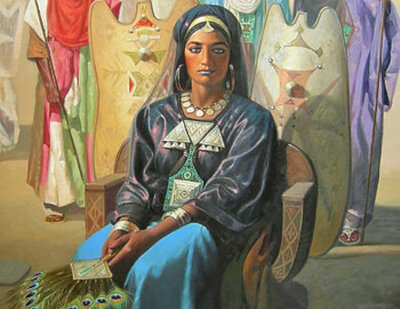
According to some historians, “Al Kahina” is a corruption of the Hebrew “HaKohenet” meaning “the priestess” or someone who descended from the Israelite priestly class. There is one tradition that describes Kahina as a descendant from a priestly family forcibly deported from Jerusalem by Pharaoh Necho in the days of the Biblical King Josiah.
Kahina was the daughter of Tabat, chieftain of the Jarawa tribe, and grew up in a world of diversity, prosperity, and peace. During her youth, the Maghreb was a semi-autonomous region known as the Exarchate of Africa, which was governed by the Byzantine (formerly Roman) Empire. Kahina would have had extensive contacts with a variety of ethnic and religious groups that included both local residents and foreign merchants. The cosmopolitan environment included Berbers, Romans, Vandals, Visigoths, black Numidians, Jews, Christians, and pagans. The Jarawa and many of the Berber tribes lived in the border regions between the Exarchate and the Sahara Desert, kind of like the suburbs, but freely entered the coastal cities of the Exarchate, especially Carthage, to exchange goods at the seaports, which facilitated international trade across the Mediterranean and beyond.
Kahina had a unique appearance and personality. With her long black hair, large black eyes, unusually tall height, intelligence, wisdom, alertness, and charismatic personality, she sometimes intimidated her male counterparts. One of her suitors was a chieftain from another local tribe. When his request for her hand in marriage was refused, he exerted pressure on the Jarawa through raids and thievery. Kahina went into hiding for a certain period of time, but she eventually agreed to his proposal. Legend has it that on their wedding night, she pierced her new husband’s skull with a nail.
While she was a fierce leader, her followers also attributed supernatural powers to her. She had incredible foresight and some even described her as a prophetess. She had the habit of communicating with animals, especially birds, and was strongly connected to nature.
After the death of Muhammad in 632 C.E., the newly united Arab tribes of the Rashidun Caliphate conquered most of the Middle East from the Byzantine and Persian empires within less than a decade. The campaign across North Africa, however, was much more challenging for the Arabs and took more than half a century to accomplish after many attempted invasions and military defeats. Although the Byzantine navy was not able to send reinforcements to their far-off colony in the Maghreb, the Exarchate of Africa relied on auxiliary troops of Berber tribes to exert military pressure on the invading Arabs and keep them as far as possible from its borders.
During the 680s, Kahina learned the art of war from her uncle, the great Berber chieftain Kusaila who fought off several Arab invasions. Kahina participated in these battles as a warrior and eventually took a command position. She was said to have been an excellent horse rider, fast with her sword, and never missed her target as an archer.
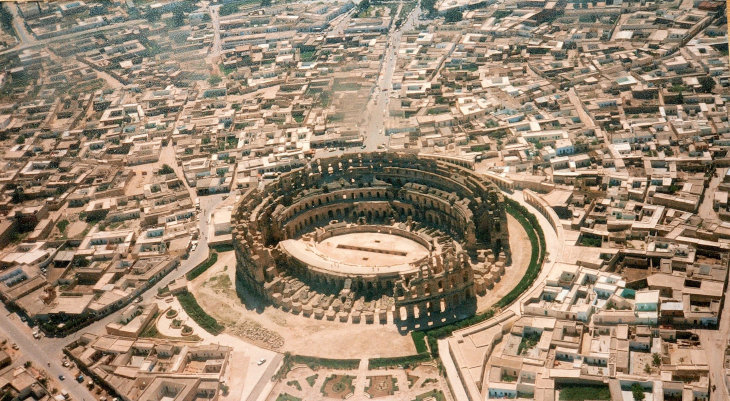 El Djem Amphitheater aerial view. The amphitheater was converted into a fortress, and in 699 CE served as a refuge for Kahina during her fight against the Arab invaders. After the battle, the town was abandoned, and the site was reoccupied only during the French colonial period.
By 697 C.E., the forces of the Exarchate and their Berber allies were exhausted and diminished after decades of conflict. The Arab general Hassan Ibn Numan of the Umayyad Caliphate advanced against Carthage (the capital of the African Exarchate) with an unprecedented 45,000 well-trained Arabian foot soldiers. Before reaching the city, the people of Carthage, most of whom were of Roman origin, fled to Sicily off the Italian coast. The following year, the Byzantine navy reemerged to liberate Carthage and called for its population to return home. After the city was repopulated, Hassan’s forces returned and faced fierce resistance from the locals. To avenge his losses, Hassan massacred the people of Carthage and ordered the full demolition of the city.
The destruction of the great city of Carthage sent shockwaves through the tribes of North Africa. Kahina used this event to rally and unite all the Berber chiefdoms into a singular confederation with one common cause, to fight off the Arab invaders and liberate their homeland.
Beginning with guerilla warfare, Kahina and her forces eventually confronted the Arab armies in open warfare on the battlefield with stunning success. Encouraged, survivors of the Exarchate’s army and some Visigoth tribes joined the confederation under Kahina. General Hassan, frustrated by local resistance, inquired about Kahina’s whereabouts and planned to attack her on her home turf in the Aures Mountains. Anticipating this move, Kahina led her forces into strategic hiding places in the mountains where she grew up. As Arabian soldiers entered the area, they were ambushed and thoroughly defeated. With no other choice, Hassan withdrew his surviving forces and returned to Arab occupied Egypt.
After succeeding to oust the invaders, Kahina ruled over the region as the uncontested warrior-queen of North Africa for several years. Had she succeeded in the long term, it’s likely that the Maghreb and West Africa would never have become Arabized and Islamicized. Likewise, Arab-Muslim forces never would have reached Europe (the Iberian Peninsula). History as we know it would have been quite different.
Five years after her first confrontation with the Arab general, Hassan Ibn Numan returned with an outrageously large military force that greatly outnumbered the Berber confederation. So confident in his upcoming victory that he sent messengers to Kahina granting her amnesty as long as she pledged allegiance to the Caliphate and converted to Islam.
Kahina sent a response back to Hassan, “I shall die in the religion I was born into.”
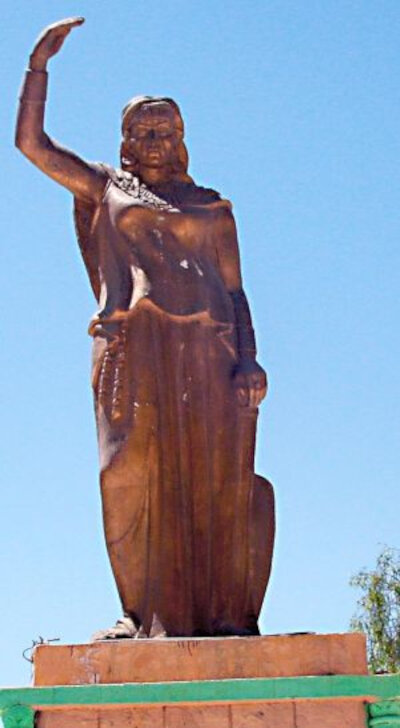 Dihya Kahina memorial in Khenchela, Algeria
As the battle raged, Kahina fought valiantly, but ultimately met her fate while preserving her Judaism. After Kahina fell, there was no further Berber resistance. Hassan and his Arab-Muslim forces now dominated the North African landscape. The Jewish Berber tribes gradually and reluctantly gave in to Islam, but those Jews outside of the Berber tribal system perpetuated their Jewish identity for centuries. The Jewish communities of the Maghreb were eventually reinforced by an influx of tens of thousands of Jews from the Iberian Peninsula following the Spanish Inquisition in the late 15th century.
In modern times, the story of Kahina has served as a role model of female leadership for both the Jewish and Muslim communities of North Africa. The legends of Kahina inspired both the Jewish resistance against the Nazi occupation of Algeria during World War II as well as the Algerian National Movement’s fight for independence from France in the 1950s. The French themselves have even compared her to Joan of Arc and in 2001 erected a large statue of the Kahina in Parc de Bercy in Paris. Her name was also mentioned in an episode of the American TV series Xena: The Warrior Princess.
While most of us are familiar with the classic examples of Jewish female leadership such as Golda Meir, Hannah Senesh, and Queen Esther, let’s not forget about Kahina, the Warrior-Queen, and everything she represented; strength, spirituality, and freedom!
Sources:












These European Khazzar tribes from Europe converted to a religion. But they are not and I repeat, they are not the descendants of the original black Judeans from the land of Judea that were exiled in 70ad by the Roman empire. And I'm pretty sure Kahina the African Hebrew queen was not a descendant of the European Ashkenazi jews. The word jew itself is a modern term, which mostly deals with the European jews who converted to the religion of Judaism. The original term would be Judeans or in Hebrew (Yehudeans). Who was not European. Just sharing true history.
I agree, that the writer has l lot of historical facts incorrect. The first thing thats important to understand. Alkubulan, the original name of Africa. Meaning was the Garden of Eden. Do your research. So when we talk about the biblical regions of the Bible and all the ancient civilizations, it's important to know we're talking about black civilizations. The kings of the great Persian empires ,Assyrian, Babylonians, Egyptians and the black Yehudeans(Judeans). This is why when the Roman's attacked The Judeans in 70AD. Most of the black Judeans fled or migrated south further into Africa amongst people who look like them. Book reference (Hebrewism of West Africa). When you speak of the Ashkenazi or Sephardic Jews, these are European jews who converted to the religion of Jews. The Khazzars.
Are there any inscriptions, contemporary Berber records, or independent evidence that she identified as Jewish?
This is entirely mythological and not a single historical source is referenced. It's implied that Josephus wrote of Kahina which is impossible since he lived centuries before the time of the myth. It is simply wrong that Berber Jews had come from Judea. DNA analysis of Berber Jews shows that they have zero Levantine DNA -- they are fully Berber, descendants of the people of Carthage.
Wonderful article. I never heard of Kahina, thank you very much for this and so many other interesting and informative topics you publish.
Kahina was unknown to me before I read this article, so thank you for sharing it.
I really appreciate the work done to bring this knowledge into greater awareness. I too would like to do further reading into this lady. I just checked on google and I found no books on this subject.
I heard about a barber queen called Helen that converted to Judaism, but I never heard of Kahina warrior princess this story sounds like the comic book Wonder Woman a Amazon princess, did this person actually exist or thia like a fable, like the golem of Praque
Well then you need to read about Boudica Warrior Queen of The Iceni.
Wow, so interesting!
Real interesting article, however I got stuck in this article comment
" While the 47,000 Jews who landed in Italy became the progenitors of the Ashkenazi community who later spread across the European continent .."
The Jews did relocate to Italy from various locations. Some from North Africa, others from Iberia & some from Southern France - L Óccitane. Those from LÓccitane settled in the territory of the Marquesado de Saluzzo, & even today there is an affinity to the community of L 'Occitane which had Jewish roots The Jews that settled in Italy were Sephardim and tended to remain in Italy. Their DNA is also very different from the Ashkenazi. Therefore, the Italian Jews could not be the progenitors.
Agreed, genetic research fails to support the claim that Jews who landed in Italy were the progenitors of the Ashkenazi community. See particularly these findings by scientists from Harvard Medical School and Hebrew University: https://hms.harvard.edu/news/ancient-dna-provides-new-insights-ashkenazi-jewish-history.
That sentence in the article is talking about the Jews who were first forced into exile to Italy by the Romans, as opposed to Carthage. Your thoughts are covering a much later time frame. Your point may ultimately be correct, but that is precisely because so many of the Jews who were originally exiled by the Romans to Italy (the "first wave") eventually moved on and settled in Ashkenaz instead, and in this way they formed the Ashkenazi Jewish demographic. That's what the sentence is trying to say. But that doesn't change the fact that Ashkenazi Jews primarily came from that first wave of Judeans who were exiled by the Romans to Italy.
This story is fascinating, but I’m curious—are there sources that clearly support some of these claims? For example, Josephus mentions Jews being deported after the First Roman-Jewish War, but are there specific sources that document the numbers and locations, like the 30,000 sent to Carthage? Also, is there evidence that directly links these deported Jews to the Sephardic and Ashkenazi communities? And what about the idea of them marrying Berber women who converted to Judaism—are there historical sources that confirm this? I’d love to see any references you have!
I see a list of sources under the article.
Dvirah - the sources mention Jews in North Africa and interactions with Berber tribes but don't provide concrete evidence for key claims:
1. The figure of 30,000 Jews deported to Carthage by Titus is based on later interpretations - there are no PRIMARY sources that mention it.
2. The idea that these Jews directly formed the Sephardic community is completely speculative, with no definitive lineage established.
3. Claims of widespread intermarriage with Berber women are more legendary than factual - there is no strong documentation for it.
So to me, these narratives are more interpretive than historically confirmed.